

About Course
Topic: Clinical
CEU: 1.5 units
Contact Hours: 15 hours
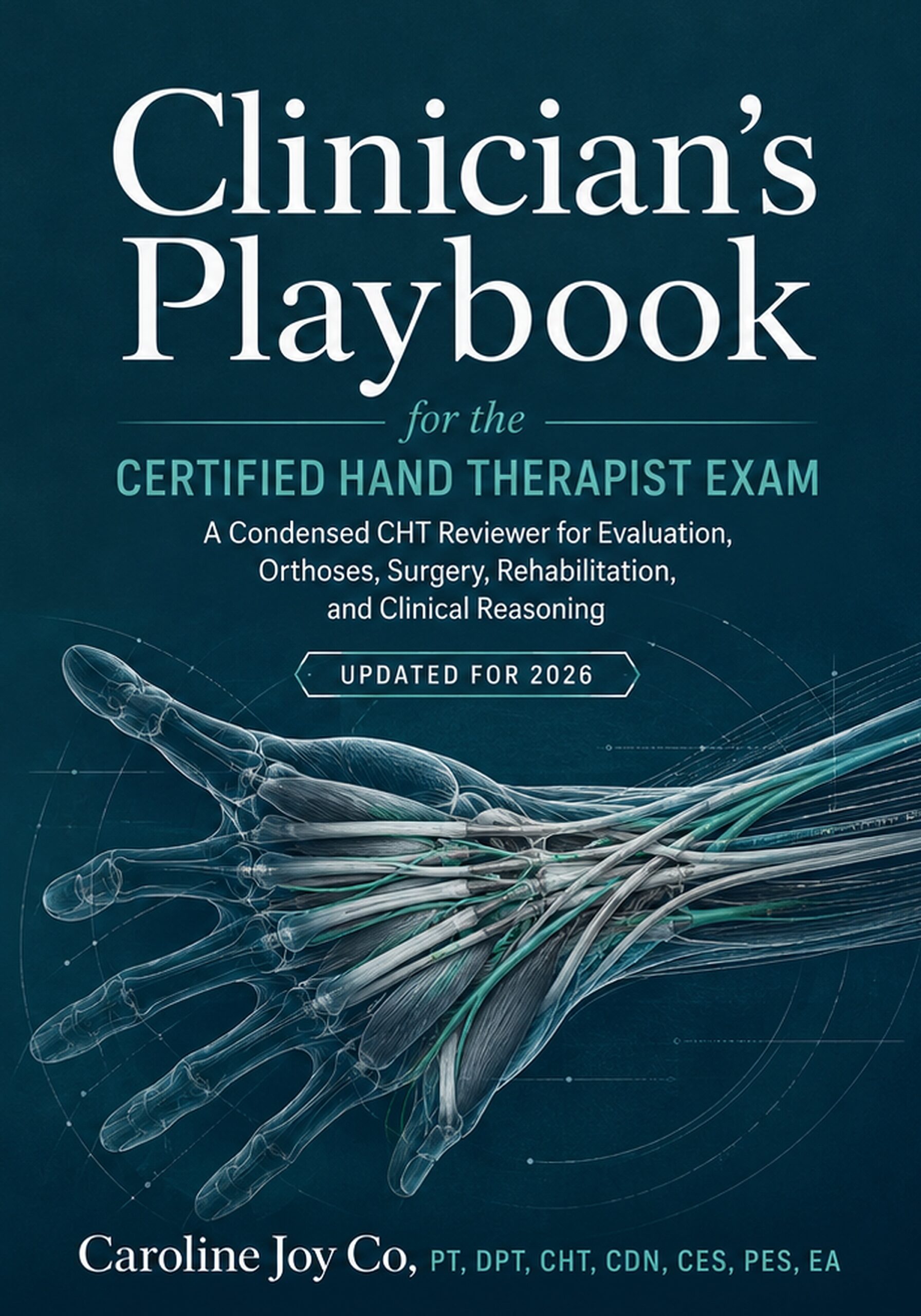
A Condensed CHT Reviewer for Evaluation, Orthoses, Surgery, Rehabilitation, and Clinical Reasoning
Clinician’s Playbook for the Certified Hand Therapist Exam is a focused clinical-review course for physical therapists, occupational therapists, hand therapists, students, residents, and clinicians preparing for advanced hand-therapy practice or CHT examination review.
This course is designed to strengthen clinical reasoning for hand and upper-extremity rehabilitation. It reviews the Hand Therapy Certification Examination blueprint, upper-limb anatomy, biomechanics, tissue healing, pain science, edema, scar management, wound care, CRPS, examination tools, orthotic reasoning, physical agent modalities, therapeutic exercise, manual therapy, sensory re-education, nerve injuries, tendon repairs, fractures, arthritis, trauma, burns, amputations, work rehabilitation, functional capacity evaluation, return-to-work planning, and documentation.
This course covers:
• How to study for the Certified Hand Therapist Exam
• HTCC examination blueprint domains
• Research, evidence-based practice, and exam reasoning
• Upper-limb anatomy and biomechanics
• Tissue healing, pain, edema, scar, wounds, and CRPS
• Examination, measurement, and outcome tools
• Orthotic reasoning for hand therapy
• Physical agent modalities and precautions
• Exercise, manual therapy, sensory re-education, and neuromuscular re-education
• Shoulder, scapula, elbow, and forearm foundations
• Wrist, DRUJ, TFCC, and carpal instability
• Thumb, digits, arthritis, deformity, and stiffness
• Flexor and extensor tendon injuries and repairs
• Nerve injuries, compression neuropathies, and sensibility
• Fractures, dislocations, and ligament injuries
• Complex trauma, burns, replantation, amputation, and prosthetic rehabilitation
• Pediatrics, congenital upper-limb differences, rheumatic disease, and neuromuscular conditions
• Work, ergonomics, functional capacity evaluation, return to work, and documentation
The purpose of this course is to help learners apply hand-therapy knowledge to real clinical decisions. The course emphasizes tissue protection, healing stage, surgical precautions, orthosis selection, examination findings, intervention timing, complication recognition, and safe progression toward function.
The book includes 17 chapters, a comprehensive Certified Hand Therapist practice examination, answer sheet, answer key with detailed rationales, rapid-review tables, a protocol appendix, an orthosis appendix, terms and abbreviations, a final-week study plan, and master references.
Course Content
Table of Contents
-
Clinician’s Playbook for the Certified Hand Therapist Exam Course Content