

About Course
Topic: Clinical
CEU: 1.5 units
Contact Hours: 15 hours
Clinical Reasoning for Trigger Points, Soft Tissue Pain, and Movement Dysfunction
Updated with Current Research Through 2026
The Clinical Reasoning in Physical Therapy Series
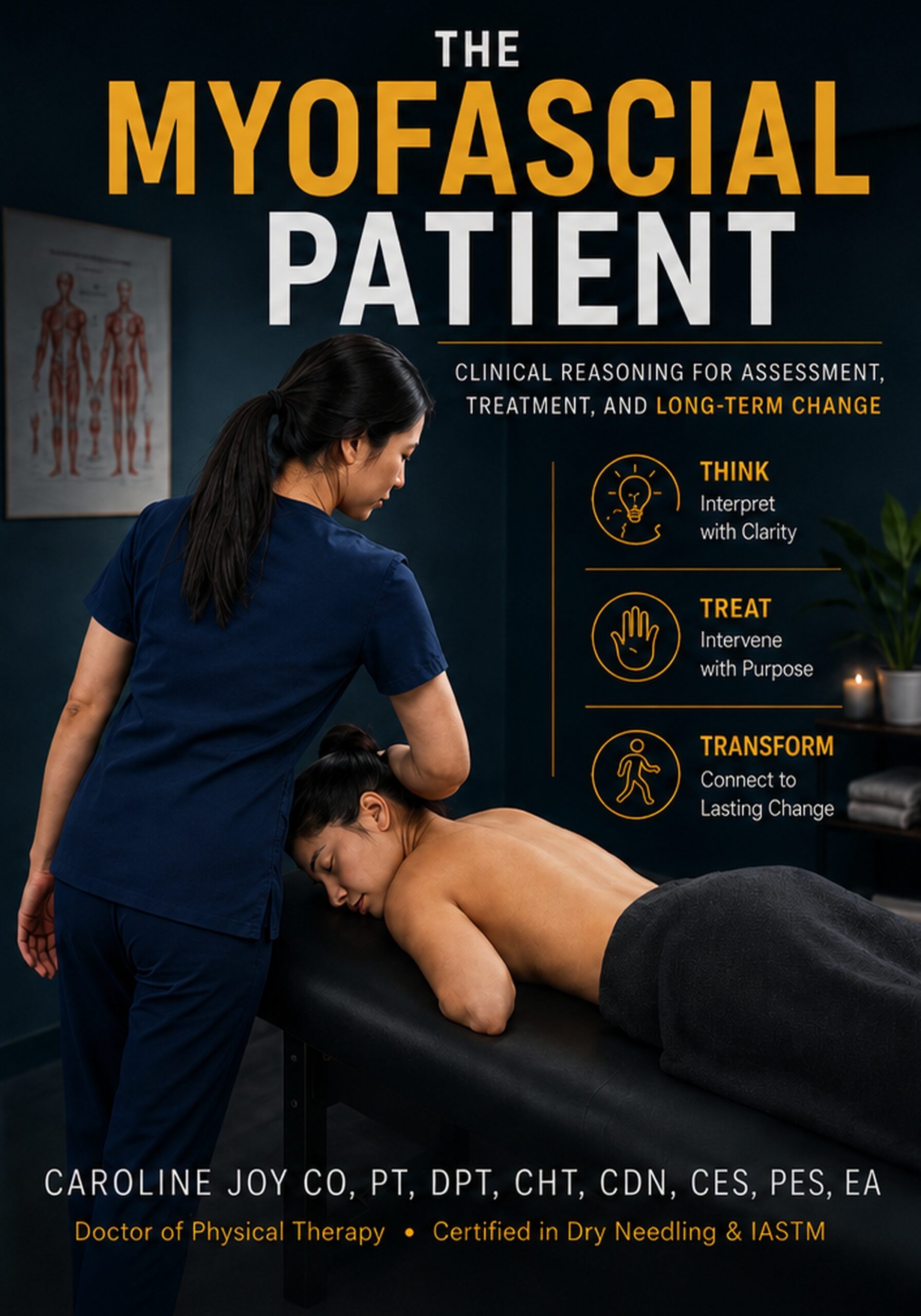
The Myofascial Patient is a clinical reasoning guide for physical therapists who treat trigger points, soft tissue pain, protective guarding, recurring “tightness,” and movement dysfunction.
Myofascial pain is familiar in practice, but it is easy to oversimplify. A patient points to a knot. The therapist finds a tender band. Treatment helps for a day or a week. Then the symptom returns. This book asks the question that matters most: What does the finding mean, and what should the therapist do next?
Written for physical therapists, rehabilitation professionals, students, and educators, this book moves beyond trigger point maps and modality-based thinking. It teaches a practical classification model for myofascial findings: dominant, secondary, compensatory, protective, sensitized, and incidental. This framework helps clinicians decide when to treat locally, when to look elsewhere, when to reduce threat, when to build capacity, and when not to chase a tender point at all.
Inside, readers will find clinical reasoning for:
• Palpation
• Movement testing and re-testing
• Irritability and dosage
• Manual compression
• Dry needling
• Instrument-assisted soft tissue mobilization
• Cupping
• Shockwave therapy
• Photobiomodulation
• Taping
• Stretching
• Heat and vibration
• TENS
• Self-treatment
Regional chapters apply the framework to the cervical spine, shoulder girdle, thoracic and rib region, lumbar spine, hip and pelvis, lower extremity, and upper extremity.
Grounded in current rehabilitation science and written in a practical clinician-to-clinician voice, The Myofascial Patient helps therapists connect symptom relief to movement, load tolerance, patient education, documentation, and functional recovery.
This is not a trigger point atlas or a protocol book. It is a reasoning text for clinicians who want to use hands-on care, exercise, education, and adjunctive tools with greater precision.
A trigger point may tell you where the patient hurts. Clinical reasoning tells you what to do next.
Course Content
Course Content
-
The Myofascial Patient Course Content