About Course
Topic: Clinical
CEU: 1.5 units
Contact Hours: 15 hours
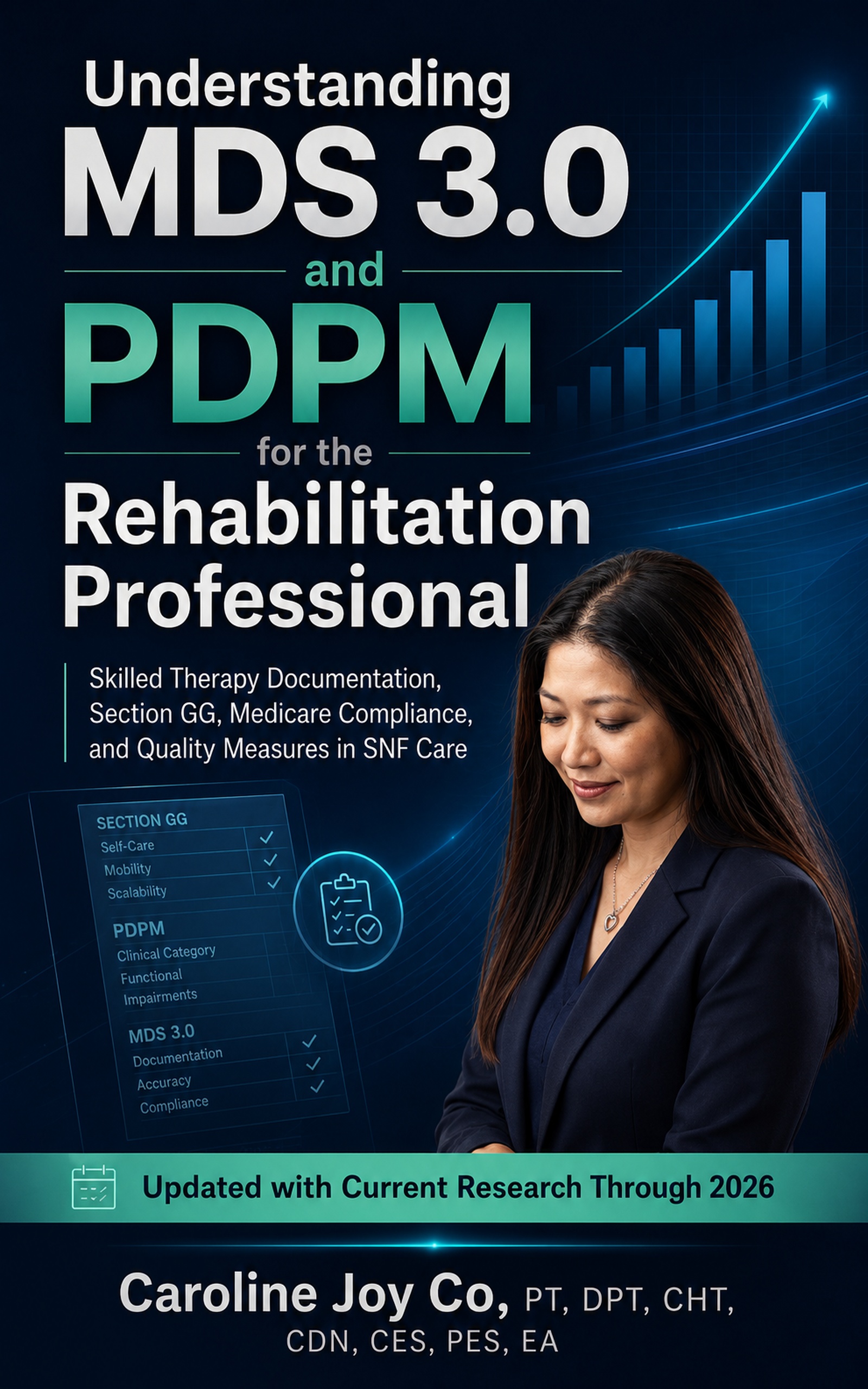
Skilled Therapy Documentation, Section GG, Medicare Compliance, and Quality Measures in SNF Care
Updated with Current Research Through 2026
Understanding MDS 3.0 and PDPM for the Rehabilitation Professional is a practical course for rehabilitation professionals working in skilled nursing facilities.
The course explains how skilled therapy documentation supports accurate MDS coding, PDPM classification, Section GG functional reporting, Medicare coverage, care planning, quality measures, discharge planning, and regulatory compliance.
Learners will examine the transition from the former RUG-IV therapy-minute model to the Patient Driven Payment Model and learn how resident characteristics—including diagnosis, functional status, cognition, swallowing needs, nursing complexity, and comorbidities—may affect the skilled nursing facility record.
Course topics include:
• MDS 3.0 fundamentals
• The transition from RUG-IV to PDPM
• PDPM components for PT, OT, and SLP
• ICD-10-CM and the primary reason for the SNF stay
• Section GG functional abilities and goals
• Section O therapy-service documentation
• Medical necessity and skilled need
• Skilled maintenance therapy
• Evaluations, plans of care, goals, and certification
• Daily notes, progress reports, recertification, and discharge summaries
• CPT coding, modifiers, therapy thresholds, units, and time documentation
• Group therapy, concurrent therapy, co-treatment, assistants, and students
• Quality Reporting Program and Value-Based Purchasing measures
• Audits, denials, Additional Documentation Requests, and appeals
• Restorative nursing and interdisciplinary carryover
• Resident rights, ethics, privacy, restraints, and legal documentation
• Managed-care authorization and denial prevention
• Internal audits and revenue protection
• Discipline-specific documentation for PT, OT, and SLP
The course emphasizes accurate, timely, resident-specific, and clinically defensible documentation. The goal is not to manipulate reimbursement. The goal is to ensure that the MDS, care plan, claim, quality reporting, and medical record tell the same truthful clinical story.
This course is intended for physical therapists, occupational therapists, speech-language pathologists, therapy assistants, rehabilitation directors, MDS coordinators, rehabilitation managers, and other skilled nursing facility professionals.