
About Course
Topic: Clinical
CEU: 1.5 units
Contact Hours: 15 hours
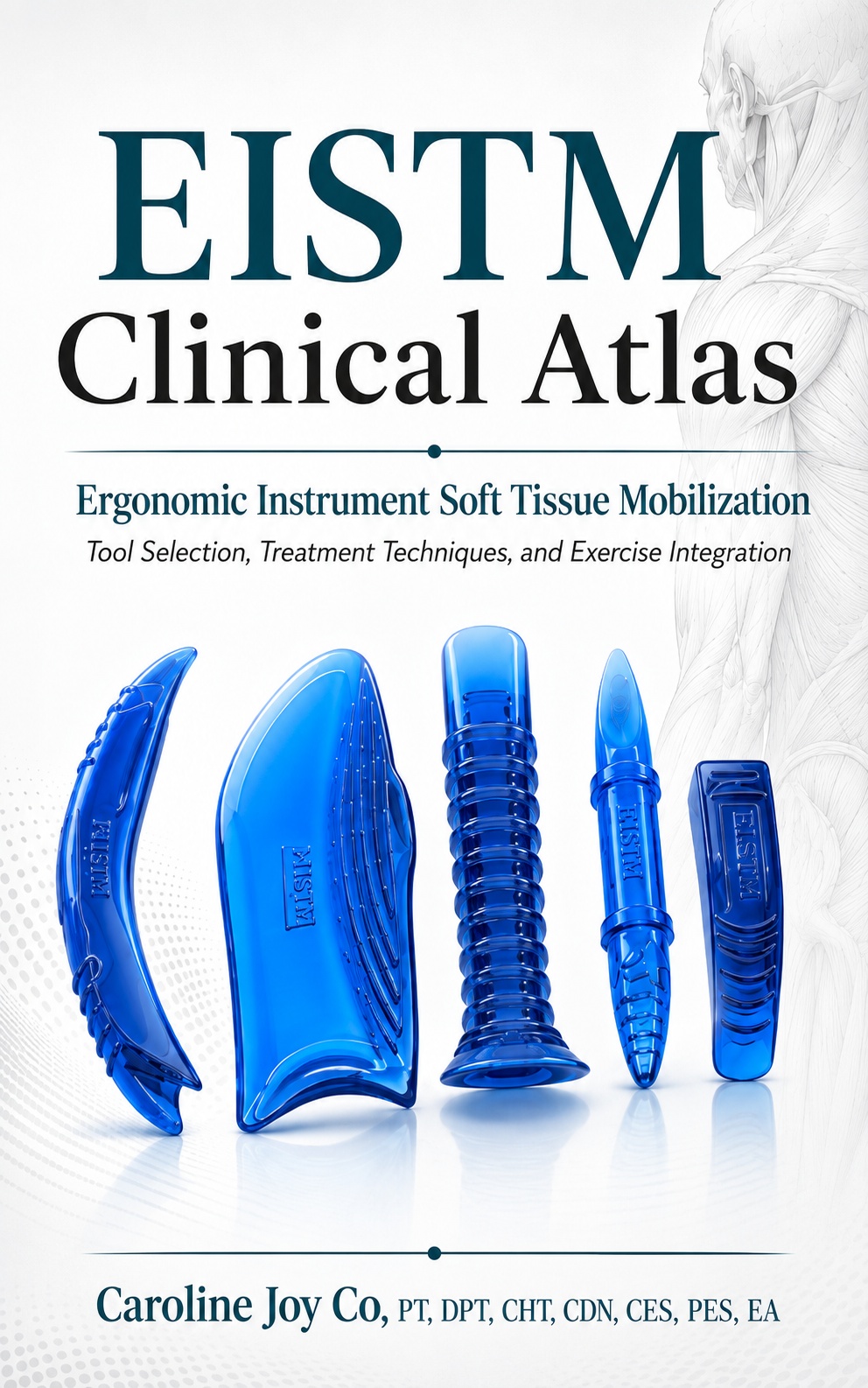
Ergonomic Instrument Soft Tissue Mobilization: Tool Selection, Treatment Techniques, and Exercise Integration
EISTM Clinical Atlas is a clinical education course for appropriately trained rehabilitation and healthcare professionals who use or supervise instrument-assisted soft-tissue mobilization within a larger patient-care plan.
This course reviews EISTM as a brief, optional manual input that begins with a patient-relevant clinical question, screening, baseline measurement, geometry-based instrument selection, conservative test dosing, reassessment, integration into active care, and documentation.
This course covers:
• Foundations of EISTM practice
• System, scope, and clinical promise
• Current evidence and appropriate claims
• Screening, precautions, and contraindications
• Examination, baselines, and reassessment
• Clinician ergonomics
• Dosage, tissue response, and stop rules
• The five-instrument system
• The Fin, Spoon, Wedge, Pen-Cylinder, and Arc
• Selecting and sequencing instruments
• Regional clinical applications
• Head, face, temporomandibular, cervical, thoracic, shoulder, arm, elbow, forearm, wrist, hand, thoracolumbar, hip, pelvic, thigh, knee, lower leg, ankle, and foot applications
• Exercise, loading, and movement integration
• Clinical pathways and cases
• Documentation and outcomes
• Infection prevention, cleaning, and instrument care
• Competency, scope, and continuing development
• Clinical checklists, encounter records, adverse-response records, processing logs, competency audits, and sample clinical protocols
The purpose of this course is to help clinicians use instrument-assisted soft-tissue mobilization safely, selectively, and defensibly. The course emphasizes that EISTM is not a complete plan of care by itself. It should be used only when it answers a meaningful clinical question, remains within scope, uses conservative dosing, produces a useful reassessment response, and connects back to movement, loading, function, or participation.
Course Content
Table of Contents
-
EISTM Clinical Atlas Course Content